Esther Greenwood—Joan Gilling
The Bell JarEsther Greenwood and Joan Gilling are joined by a relationship that is at once intimate, uneasy, and resistant to definition. Initially, Esther knows Joan only from a cool distance; later she describes her as a separate but similar crisis made visible beside her own. Their companionship becomes something Esther expects to treasure, even as she cannot fully understand Joan’s feelings or imagine what women might find in one another. Joan’s death then turns that uncertain closeness into grief, obligation, and a final encounter with the reality of another life.
From Distance to Involuntary Proximity
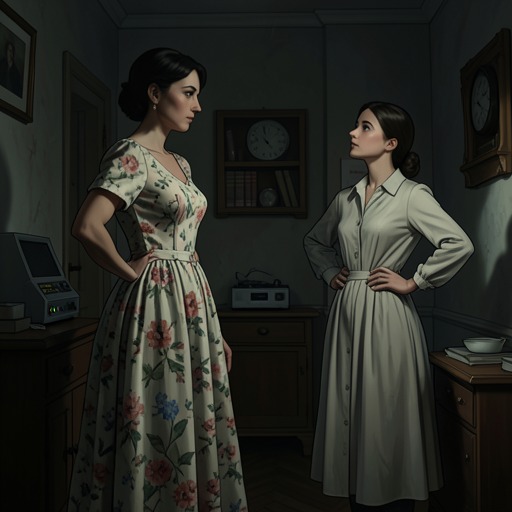
When Esther finds Joan at the asylum, Joan’s room is arranged as a mirror image of Esther’s, down to its closet, bureau, table, chair, and white blanket marked with a large blue C. The likeness prompts Esther to wonder whether Joan has taken a room there as a joke after learning where Esther was. She had not expected this proximity: until then, she had known Joan only from a cool distance. The mirrored rooms give their relationship an immediate visual form, but Esther’s suspicion also shows how difficult it is for her to take Joan’s presence at face value.
Joan is not simply an acquaintance who happens to share Esther’s institution. She enters a life Esther later imagines as punctuated by Joan’s reappearance at every crisis, as if Joan returned to remind her of what she had been and endured. Esther even wonders whether she made Joan up. This uncertainty does not establish that Joan is unreal; it reveals how completely Esther experiences her as a reflection entwined with her own history. Joan remains another person, but one whose presence makes Esther’s private crisis look less singular.
Recognition, Aversion, and the Double
Esther’s response to Joan is persistently mixed. She describes a creepy feeling and an old, ingrained dislike, yet admits that Joan fascinates her. Joan’s thoughts and feelings are not Esther’s, she insists, but they are close enough to seem like a wry, black image of her own. The relationship therefore depends on both likeness and resistance: Joan offers Esther a way to see a parallel crisis, while her difference prevents that parallel from becoming simple identification.
That doubleness is sharpened by the physical disgust in Esther’s account. Joan’s cornhusk voice makes Esther want to vomit, and her large, gleaming teeth mark her arrival in Esther’s memory. Such reactions do not cancel the fascination; they sit beside it. Esther observes Joan almost as an alien creature, comparing her to a Martian or a particularly warty toad, while conceding that their lives have brought them close enough for Joan’s inner world to echo her own. The grotesque comparison expresses estrangement, but the sustained attention to Joan shows that she cannot be dismissed as merely repellent.
Their resemblance also unsettles Esther’s understanding of women’s intimacy. When Joan says she likes Esther better than Buddy Willard, Esther recalls a college-dormitory scandal about two women who were constantly together and had reportedly been found embracing. At the time, Esther could not imagine what men or women would actually do in same-sex relationships. She later asks Doctor Nolan what a woman might see in another woman that she could not see in a man; Doctor Nolan answers, “Tenderness.” Joan’s affection makes that question personal, even though Esther’s account does not resolve her uncertainty about desire or define the relationship as romantic.
Friendship and a Possible Future
Joan voices an attachment Esther does not fully reciprocate in the same terms. She tells Esther, “I like you. I like you better than Buddy.” Esther records the statement alongside her enduring reservations, not as a declaration that settles what they are to one another. Her response is more guarded and more enduring: despite her profound reservations, she thinks she will always treasure Joan. The distinction matters. Joan offers explicit affection; Esther recognizes a bond while continuing to experience discomfort and distance.
For a time, the relationship extends beyond the asylum. Joan has only that week regained town privileges, and she tells Esther that she will live in Cambridge with Nurse Kennedy, sharing an apartment after the nurse’s roommate marries. Esther and Joan raise apple-cider glasses and clink them. Esther imagines that they have been forced together by an overwhelming circumstance, like war or plague, and have shared a world of their own. The comparison makes their closeness feel both real and contingent: they have become companions through a crisis that set them apart from ordinary life, and Joan’s planned departure gives that shared world a near-term boundary.
Esther’s bond with Joan is also shaped by its connection to Buddy. Joan rejects him as someone who thought he knew everything about women, while telling Esther that she likes her better. For Esther, who has already made Joan’s presence part of the story of her own crises, this contrast makes Joan both an alternative to Buddy’s assumptions and an unsettlingly close witness to Esther’s past. Their companionship is not presented as uncomplicated rescue or perfect mutual understanding. Its force comes from the way affection persists alongside irritation, difference, and Esther’s inability to fully imagine Joan’s inner life.
Death and the Meaning of the Bond
The relationship changes irrevocably when Doctor Quinn tells Esther that Joan has been found. The announcement is delivered in the passive voice, which Esther says slows her blood; when she asks where, Doctor Quinn answers that an orderly found Joan while coming to work. Esther’s unfinished question is answered directly: Joan is dead, having hanged herself. The news ends the future the two women had discussed, including Joan’s plan to leave for Cambridge, and makes their last shared world one that Esther must remember without Joan.
After Joan’s death, Nurse Kennedy moves elsewhere and leaves no trace. Esther recognizes that Irwin has no way to contact her except through the nurse’s flat and concludes, “I was perfectly free.” That practical freedom appears in the same stretch of the narrative as the funeral arrangements, but it does not erase the relationship. Joan’s parents invite Esther, and Mrs. Gilling says Esther had been one of Joan’s best friends. The description gives their closeness an external name that Esther herself had never quite supplied. Doctor Nolan tells Esther she need not go and could instead write that the doctor thought it better not to; the invitation and the permission to decline leave Esther facing what the friendship requires of her after Joan can no longer speak for herself.
Esther imagines the grave as a six-foot-deep gap in hard ground, its wound sealed by the locality’s yellowish soil and later erased by snowfall. Against that image of burial and obliteration, she listens to her heart’s old boast: “I am, I am, I am.” Joan’s death does not become Esther’s death; rather, it leaves Esther to confront both the irreducible separateness of Joan’s fate and the continued beat of her own life. The relationship’s final significance lies in that tension: Joan has been Esther’s troubling mirror, but never merely her duplicate, and grief makes the difference impossible to overlook.